Kaiser Poll Show Support for Personal Imporatation

Kaiser Poll Show Support for Personal Imporatation
Showing posts with label Pharma Price abuses. Show all posts

Monday, December 26, 2016

Brand Name Drug Prices Increase Nearly 130 Times Faster Than Inflation

New AARP report shows fourth straight year of double-digit price average annual increases for widely used brand name drugs

Washington/PRNewswire-USNewswire/, December 2016-- Retail prices for brand name prescription drugs widely used by older Americans rose by an average of 15.5% in 2015—almost 130 times faster than the 0.1% general inflation rate—according to a new AARP Public Policy Institute (PPI) report 


AARP's Rx Price Watch Report: Trends in Retail Prices of Brand Name Prescription Drugs Widely Used by Older Americans, 2006-2015, shows that the average annual cost for one brand name drug used on a chronic basis now exceeds $5,800.

For the average older American taking 4.5 prescription drugs per month, this translates into an average annual cost of therapy of $26,000*. This amount exceeds the median income of $24,150 for Medicare beneficiaries.   

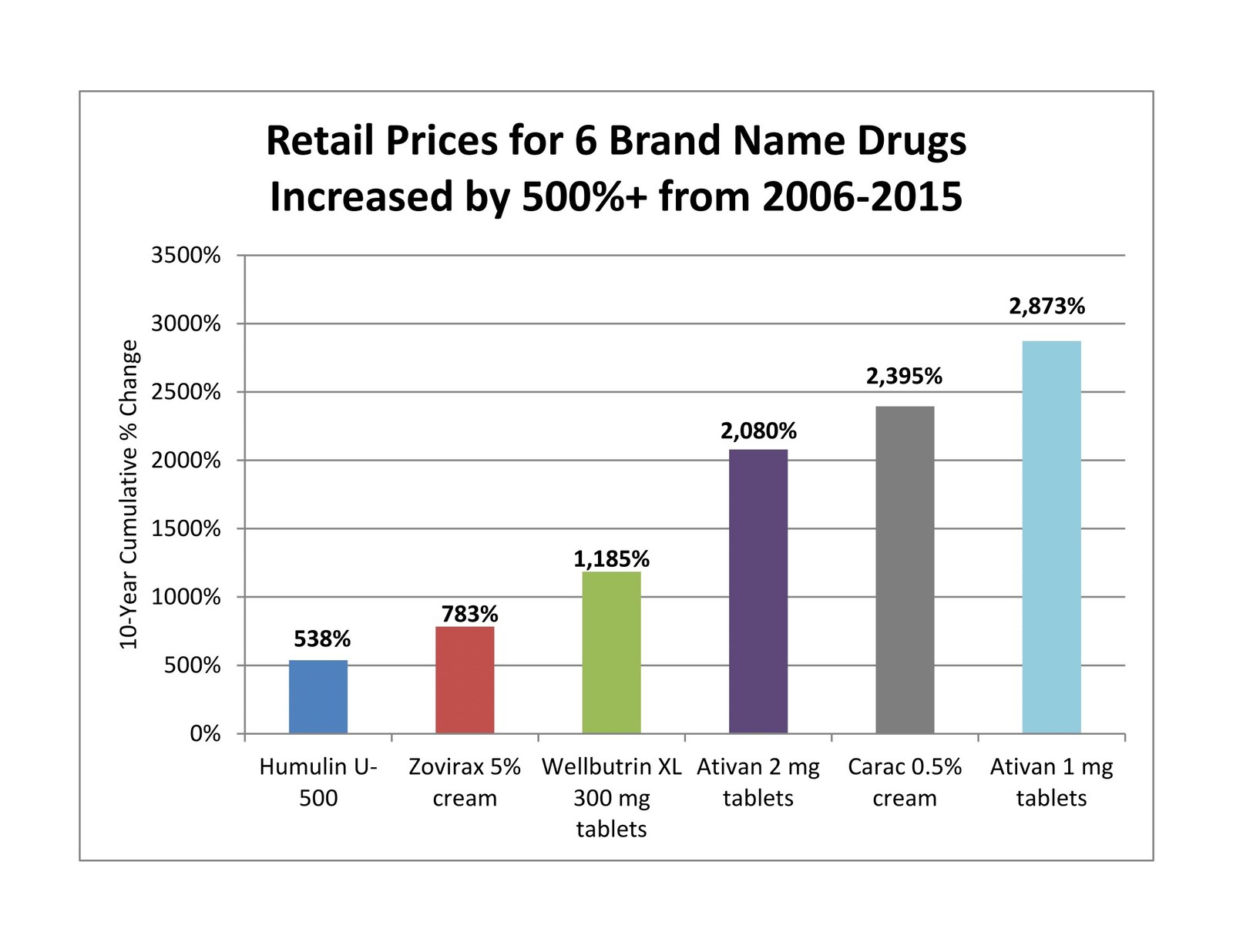
Retail Prices for 6 Brand Name Drugs Increased by 500%+ from 2006-2015

"This new report once again highlights the high and unrelenting price increases that are shockingly common in the pharmaceutical market," said AARP Chief Public Policy Officer Debra Whitman.

"What's particularly remarkable is that these incredibly high price increases are still occurring in the face of the intense public and congressional criticism of prescription drug pricing practices."

Highlights of the Rx Price Watch Report
  • The average annual retail price increase for widely used brand name prescription drugs was more than two and a half times higher in 2015 (15.5%) than in 2006 (5.9%).
  • Brand name drug prices increased almost 130 times faster than general inflation in 2015 (15.5% vs 0.1%).
  • In 2015, the average annual retail cost of one brand name medication used to treat a chronic health condition more than $5,800, compared with nearly $1,800 in 2006.
  • Retail prices increased for 97% of the 268 brand name prescription drugs in the study's market basket.
  • Seven widely used brand name drugs had average annual retail price increases of over 50% in 2015.
  • Five of the six drugs with the highest cumulative price increases over the study period were marketed by Valeant Pharmaceuticals. The retail price of Valeant's anti-anxiety drug, Ativan 1 mg tablets, increased by 2,873% between 2006 and 2015.

"Prescription drug therapy is not affordable when its cost exceeds the patient's entire income," said Leigh Purvis, Director of Health Services Research, AARP Public Policy Institute, and co-author of the report.

 "Even if patients are fortunate enough to have good health care coverage, high prescription drug costs translate into higher out-of-pocket costs—especially for those who pay a percentage of drug costs rather than a fixed copayment—as well as higher premiums, deductibles, and other forms of cost-sharing."

Rx Price Watch Report Methodology

AARP's Public Policy Institute, in collaboration with the PRIME Institute at the University of Minnesota, developed a market basket of 268 brand name prescription drug products widely used by older Americans.

Using data from the Truven Health MarketScan® Research Databases, the report analyzed retail price changes between 2006 and 2015 for the drug products in the market basket.

The medications include products in 49 therapeutic categories used to treat common and often chronic health conditions, including high cholesterol, diabetes, and hypertension.

This report is the latest in the AARP Public Policy Institute's Rx Price Watch series. Separate reports analyze price changes for widely used generic and specialty drug products.

The series also analyzes the price changes for an overall market basket (i.e., brand name, generic, and specialty drug products combined) to reflect the overall market impact of drug price changes.

The full report can be found here: http://www.aarp.org/rxpricewatch

*These prices reflect the total costs for specific prescriptions and may not reflect the actual out-of-pocket costs (such as a copay) that a consumer would pay at the pharmacy.

Friday, September 30, 2016

BLUMENTHAL, GRASSLEY, KLOBUCHAR CALL FOR DEPARTMENT OF JUSTICE TO CONSIDER INVESTIGATING MYLAN

Mylan may have knowingly misclassified the EpiPen in order to reap huge profits at the expense of states and taxpayers

Mylan might be target of DOJ investigationWASHINGTON, D.C., September 30, 2016 – U.S. Senators Richard Blumenthal (D-CT), member of the Judiciary Committee, Chuck Grassley (R-IA), chairman of the Judiciary Committee, and Amy Klobuchar (D-MN), ranking member of the Judiciary Subcommittee on Antitrust, Competition Policy, and Consumer Rights, have called on the Department of Justice (DOJ) to consider investigating whether Mylan Pharmaceuticals violated the law when it apparently misclassified its EpiPen product in order to pay a lower rebate to states and reap huge profits at the expense of taxpayers.

“The American people have been rightly outraged as Mylan engaged in substantial price increases that resulted in billions of dollars paid by U.S. consumers,” the Senators wrote. “They deserve to know whether the company also violated the False Claims Act and diverted millions of dollars from U.S. taxpayers.”

More than ten years ago, Mylan classified EpiPen as a “Non-Innovator Multiple Source Drug,” or generic drug, for purposes of the Medicaid Drug Rebate Program. In order to protect states from high pharmaceutical prices, the Medicaid Drug Rebate Program requires drug companies to pay a percentage of their revenues to states in the form of rebates. Under this program, companies like Mylan are required to pay a higher rebate for brand-name drugs than for generic drugs. In a letter to the DOJ today, the Senators cited evidence that Mylan may have knowingly misclassified EpiPens, potentially in violation of the False Claims Act and other statutes. 
                                                                                   
The text of the letter is available here and below.

Dear Attorney General Lynch:

We write to inquire whether the Department of Justice has considered an investigation into whether Mylan Pharmaceuticals violated the law when it apparently misclassified its EpiPen product for purposes of the Medicaid Drug Rebate Program.

Congress created the Medicaid Drug Rebate Program to protect states from high pharmaceutical prices by requiring drug companies to pay a percentage of their revenues to states in the form of rebates. Crucially, the Medicaid Drug Rebate Program distinguishes between “innovator drugs”—new products that are generally insulated from generic competition by patents—and “non-innovator multiple source” (NIMS) drugs—older products that are available from multiple sellers. Companies pay a rebate of 13 percent of the price of non-innovator drugs. For innovator drugs, sellers pay a minimum rebate of 23.1 percent, but they can pay far more for drugs that experience large price hikes.

Pharmaceutical companies are responsible for determining whether their products are innovator or NIMS drugs. Companies can reap huge profits, at the expense of the states and taxpayers, by misclassifying innovator drugs as NIMS drugs. In the past, the Department has secured settlements against drug companies under the False Claims Act for such practices—including against Mylan Pharmaceuticals.[1]

Mylan has classified the EpiPen as a NIMS drug since acquiring the product license in 2007. According to press reports, however, the Center for Medicare and Medicaid Services (CMS) has stated publicly that this is incorrect.[2]

The first indicator that the EpiPen should not be classified as a NIMS drug is the plain text of the relevant statute. Under section 1927(k)(7)(A) of the Social Security Act, for a drug to be classified as a NIMS there must be “at least 1 other drug product which . . . is rated as therapeutically equivalent.[3]” In other words, the NIMS drug must face an FDA-approved competitor. The EpiPen faces no such competitor, and it has not since Mylan began selling the product.


The second indicator comes from Mylan’s own behavior. The Medicaid Drug Rebate Program imposes a higher rebate on innovator drugs because innovator drugs are generally protected by patents. Shortly after Mylan began marketing the EpiPen, it sued Teva Pharmaceuticals for patent infringement, leading to a settlement that kept Teva out of the EpiPen market until late 2015.[4] During this timeframe, Mylan increased its prices dramatically, including a rise from $265 to $609 in the last three years.[5]